

Multilayer PCB: The Engine of Modern Electronics

At LHD TECH, we live and breathe the push for smaller, smarter electronics. A huge part of making that happen? Multilayer PCB Technology. It’s not just something we offer—it’s one of our core superpowers.
Think of it this way: Multilayer PCBs are how we pack more brains into less space. We take what used to require several bulky boards and engineer it into one sleek, compact unit by meticulously stacking and fusing multiple circuit layers together. This is the secret sauce behind devices that keep getting thinner, lighter, and massively more powerful.
Unlike simpler single-layer PCBs or double-sided PCBs, our multilayer tech unlocks the third dimension. We route complex, high-speed signals up, down, and through multiple insulated layers. This gives our designers incredible freedom and delivers performance that simpler boards just can’t touch.
Why are multilayer PCBs so important?
- They’re the Innovation Engine: Think of our multilayer PCBs as the unsung heroes inside the tech that moves the world. They’re in your smartphone, critical medical gear, the data centers behind the cloud, and even satellites in space. If it’s advanced, our boards are likely at its heart.
- Built to Handle the Tough Jobs: We engineer these boards for missions where there’s zero room for error. When a device can’t afford to be bigger, slower, or less than perfectly reliable, our PCBs are the solution.
The Secret to Smarter, Lighter Tech: This is how you pack more brains into the same space. Multilayer tech lets us cram powerful features and wireless connections into a product without making it bulkier or heavier. It’s what devices often use multilayer PCBs.
Multilayer PCB Board Process Capability
| Item | Standard |
| Layer | 4L – 40L+ |
| Min Thickness | 0.40mm – 0.20mm |
| Max Thickness | 3.2mm – 6.0mm |
| Thickness Tolerance | ±5% – ±10% |
| Max Panel Size | 500mm x 1200mm |
| Inner Copper | 0.5 oz – 10 oz |
| Min Drill | 0.20mm (8mil) – 0.15mm (6mil) |
| Aspect Ratio | 10 : 1 – 15 : 1 |
| Drilling Position Tolerance | ±2mil (0.05mm) – ±1mil (0.025mm) |
| Registration | ±3mil (0.075mm) – ±2mil (0.05mm) |
| Resin Plugging | Blind/Buried Through-hole Resin Plug/VIPPO/POFV |
| Min L/S | 3mil – 2mil |
| Impedance | ±5% – ±10% |
| Solder Mask | Green, white, blue, red, black, yellow,Matte, Purple, Custom Colors |
| Min SM Dam | 3mil (0.1mm) – 4mil (0.075mm) |
What is a Multilayer PCB?

Definition of Multilayer PCB
In our practice, a multilayer PCB is a printed circuit board by its integrated, three-dimensional structure. It is constructed by laminating three or more layers of conductive copper, each precisely separated by specialized insulating dielectric material.
This is where we leave simple boards behind. While single and double-layer PCBs work in 2D, our multilayer solutions build upward—integrating multiple circuit layers into one compact, interconnected unit. This unlocks intricate, high-density circuit design and provides the electrical stability needed for top-tier performance: think cleaner signals, controlled impedance, and much lower interference.
Key Differences Among PCB Types
| PCB Type | Layer Count | Typical Use | Complexity |
| Single-Layer PCB | 1 | Simple toys, LEDs, calculators | Low |
| Double-Sided PCB | 2 | Appliances, power supplies, radios | Medium |
| Multilayer PCB | 3 up to 32+ | Phones, computers, medical devices | High |
Multilayer Philosophy: Building in Three Dimensions
For us at LHD TECH, the concept of a multilayer circuit board is the core of advanced electronics manufacturing. It is the engineered art of strategically stacking multiple, precise layers of conductive and insulating material into a single, high-performance system.
In our hands , we see each layer in a multilayer PCB as a step up in performance. Every sheet we add opens the door to more complexity and function, enabling advanced features—from high-speed circuitry to stable power delivery—that flat, single or double-sided boards could never handle.
This multidimensional mindset is how we take a simple board and evolve it into the integrated, high-powered core of tomorrow’s tech.
Multilayer PCB Structure & Architecture

At LHD TECH, we engineer a multilayer PCB consists of layers of the multilayer PCB system. We meticulously arrange and permanently bond its individual layers under heat and pressure to form a single, compact, and exceptionally reliable assembly. Each stratum in this stack has a distinct purpose, working in concert to provide optimized paths for signal transmission, efficient power distribution, and integral mechanical support.
Layers of the Multilayer PCB
- Outer layers of the board– These are the surfaces of the board, engineered for reliable component mounting and external interconnection.
- Inner layer core–The heart of complexity. These middle layers are dedicated to routing critical signal traces, establishing robust power planes, and creating continuous ground planes for stability and noise suppression.
- Layer of conductive material– The circulatory system. Every functional layer incorporates precisely etched copper traces that form the essential circuit pathways for electrons to flow.
- Prepreg/Insulator– The essential isolation. This insulating material is laminated between each copper layer, preventing electrical shorts and defining the board’s critical electrical characteristics.
- Soldermask– The protective skin. Applied over the outer layers, this coating prevents accidental shorts during assembly and shields the copper from corrosion and environmental damage.
- Outer layers of the board– The functional guide. This final printing provides component designators, orientation markings, and logos, ensuring accurate and efficient assembly.
Multilayer PCB Architecture Diagram
| Layer Name | Main Function | Example Use |
| Top Layer | Components/SMD, test | Mounting chips, interface pads |
| Signal Layer | Routing signals | High-speed buses, clocks |
| Power Plane | Power distribution | VCC, core voltage supplies |
| Ground Plane | EMI control | Common reference for signals |
| Bottom Layer | Components, connectors | DIP, edge connectors |
Why Multilayer is the Right Choice?
Our multilayer technology grants designers the power to:
- Manage High-Density Layouts: We pack more functionality into a smaller footprint, essential for today’s miniaturized devices.
- Implement Advanced Isolation: We enable the clear separation of analog and digital grounds, a fundamental requirement for preventing noise and ensuring signal purity.
- Provide Integrated Shielding: Sensitive traces can be shielded between solid ground planes, dramatically reducing interference and crosstalk.
This combination of capabilities makes the use of multilayer PCBs from LHD TECH not just beneficial, but essential. They are the enabling platform for high-performance applications in RF and wireless communications, sophisticated power management systems, and complex mixed-signal processing devices where signal integrity is paramount.
Types of Multilayer PCBs and Layers

Multilayer PCBs can be divided by the number of conductive layers as well as the type of construction, whether standard rigid, dynamic flexible multilayer PCB, or integrated rigid-flex.
Common Multilayer PCB Types
- 4-layer PCB:Our go-to solution for basic digital or analog devices. LHD TECH optimizes the layer stack-up (typically Signal-Ground-Power-Signal) to provide a perfect balance of performance, simplified EMI management, and cost for a wide range of consumer and industrial products.
- 6-layer PCB: We frequently recommend this configuration for embedded applications and advanced microcontroller systems. By designing dedicated internal power and ground planes, our engineers effectively isolate sensitive signals, significantly reducing noise and crosstalk for more stable and reliable operation.
- 8+ layer PCB:When performance is non-negotiable, LHD TECH delivers high-layer-count boards essential for high-frequency communication, server motherboards, and advanced computing. Our expertise in sequential lamination and precise impedance control ensures signal integrity in the most demanding RF and high-speed digital environments.
Specialty Multilayer PCBs
We push boundaries with advanced materials and hybrid constructions:
- Flexible multilayer PCB: Our engineering enables innovation in space-constrained and dynamic applications. We manufacture reliable multilayer flex circuits for foldable devices, advanced camera systems, and critical aerospace instrumentation, where repeated bending is required without sacrificing connection density.
- Rigid-flex multilayer PCB:At LHD TECH, we master the art of combining rigidity and flexibility. By integrating rigid boards for component support with flexible interconnects, we create seamless, highly reliable 3D assemblies perfect for miniaturized medical implants, wearable health monitors, and ruggedized defense electronics.
- Backplane and Embedded boards: For the backbone of network infrastructure and miniaturized sensors, we design complex backplanes for communication switches and embedded boards with microvias and embedded passive components. This maximizes functionality while minimizing size and weight.
Applications of Multilayer PCB Structures
The applications of multilayer PCBs are virtually limitless. We provide the essential platforms that enable cutting-edge technology:
- Complex beamforming and signal processing in 5G/6G antenna systems.
- Compact, energy-efficient LED drivers and smart lighting controllers.
- Dense, reliable circuitry for next-generation smart wearables and IoT edge devices.
Where standard boards fall short, LHD TECH’s multilayer pcbs are used the performance, density, and reliability your innovation demands.
Types of Vias in Multilayer PCBs
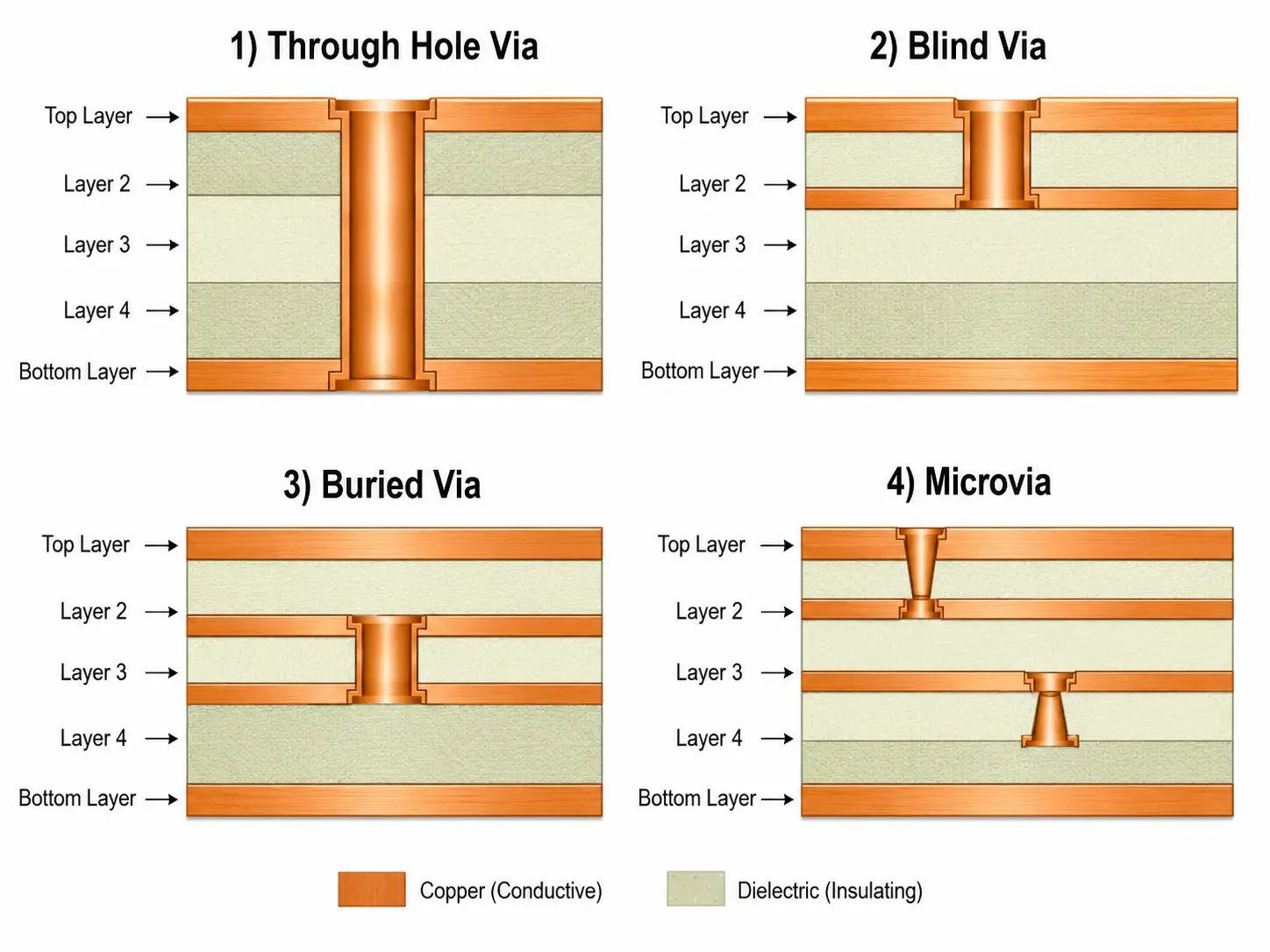
At LHD TECH, we understand that the intelligence of a multilayer PCB lies not just in its layers, but in the sophisticated interconnections that bind them. Selecting the right via technology is fundamental to achieving signal integrity, reliability, and density in our advanced designs.
We deploy blind and buried vias structures to optimize performance and manufacturability for every project:
- Through-Hole Via: Our foundational solution. This via passes through the entire board stack-up, providing a robust and reliable connection from the top to the bottom layer. It is essential for power connections, mounting through-hole components, and designs where cost-effectiveness is paramount.
- Blind Via: A key enabler for high-density designs. Engineered by LHD TECH, this via connects an outer layer to one or more inner layers without traversing the entire board. This conserves valuable routing space on layers it does not reach, allowing for more compact and efficient component placement, such as under fine-pitch components.
- Buried Via:For maximum internal routing efficiency. Completely encapsulated within the inner layers, our buried vias connect only internal layers without reaching either outer surface. This technology is critical for complex, high-speed digital boards, allowing additional signal routing channels between power planes while maintaining a pristine outer layer landscape for component mounting.
- Microvia: The cornerstone of our High-Density Interconnect (HDI) capability. These laser-drilled, ultra-small vias (typically <150µm) are essential for escaping modern, high-pin-count Ball Grid Array (BGA) packages and enabling advanced stacked and staggered via structures. LHD TECH leverages microvias to achieve the miniaturization and performance required in cutting-edge consumer, medical, and communication devices.
How Do Multilayer PCBs Work?

To us, a multilayer PCB is more than just materials—it’s a fully engineered electronic ecosystem. By bonding multiple conductive and insulating layers into one compact structure, we achieve three key things: dramatically higher circuit density, smarter functional integration, and electrical performance that simple boards can’t touch.
Key Principles
Our multilayer designs are governed by these key engineering principles to guarantee functionality and reliability:
- Separated Signal Paths:We give critical signals their own dedicated routes—either on separate layers or in controlled channels. This isolation slashes crosstalk and electromagnetic interference, guaranteeing clear, high-fidelity signal transmission.
- Optimized Power Integrity:We build in dedicated power and ground planes designed for low impedance. This ensures rock-solid voltage delivery across the entire board, eliminating dips and noise that can degrade both digital and analog performance.
- Proactive EMI Control: Our strategic use of solid internal ground planes acts as highly effective shielding. This containment of electromagnetic fields is critical for the stability of sensitive analog, RF, and mixed-signal circuits.
- Heat management:We engineer thermal performance directly into the stack-up. From using heavy copper layers to integrating metal cores or thermal vias, our designs efficiently dissipate heat from high-power components, ensuring long-term system reliability and performance.
Key Advantages of Multilayer PCBs

Benefits of Using Multilayer PCBs
We’re not just building PCBs—we’re engineering smarter systems. Every multilayer board we create is designed to bring real performance gains and rock-solid reliability. That’s why our technology is the foundation behind better, next-level electronics.
Multilayer Advantage: Key Benefits for Our Clients
- Space and Weight Reduction
At LHD TECH, we focus on doing more with less. We design with higher circuit density to create smaller, lighter boards that pack more punch into every square millimeter. This is especially vital for our partners in wearables, mobile tech, and aerospace, where every fraction of a gram and every sliver of space truly matters.
- SuperiorElectrical Performance
We engineer for speed and signal integrity. Our multilayer designs utilize short, controlled impedance paths and dedicated reference planes to enhance signal speed, minimize noise, and reduce crosstalk. This results in cleaner power delivery and greater design flexibility for high-speed digital and sensitive analog circuits.
- Unmatched Design Flexibility
At LHD TECH, we build PCBs that fit your needs—not off-the-shelf boards. With our know-how, we can custom-design layer stacks that separate analog, digital, power, and ground signals. This gives us the flexibility to meet the exact electrical and mechanical demands of a variety of specialized fields, whether it’s a vehicle control module or a life-saving medical scanner.
- Enhanced Durability and Robustness
We build boards that stand up to real-world use. An LHD TECH multilayer PCB isn’t just layered—it’s laminated into one solid, durable structure. That makes it naturally stronger, more resistant to vibration, heat, and tough conditions than simpler single or double-sided boards. So when the going gets tough, our boards keep performing.
- Inherent Reliability
Simplicity leads to reliability. By integrating multiple connections within the board itself, our multilayer designs significantly reduce the number of external solder joints and interconnects required in systems built from multiple single-layer boards. This fundamental design approach lowers the potential for field failures, delivering the dependable performance that defines the LHD TECH standard.
Navigating Complexity: The LHD TECH Perspective on Multilayer PCB Challenges

Disadvantages of Multilayer PCBs
Transparency is at the heart of how we work. While multilayer PCBs deliver unbeatable performance, they also bring unique challenges. At LHD TECH, we don’t just build your board—we partner with you to navigate those complexities using our expertise and engineering solutions, so you end up with a design that’s both cutting-edge and manufacturable.
Key Considerations for Multilayer PCB Development
1.Higher Manufacturing Costs:
Building a multilayer PCB is complex—it requires exact alignment, repeated lamination, and careful material handling. At LHD TECH, we invest in high-end equipment and tight process controls, especially for advanced features like blind/buried vias and HDI tech. This naturally adds to the upfront cost compared to simpler boards, but we partner with you to streamline the design, keeping it cost-effective without sacrificing the performance you need.
2.Longer Lead Times:
Precision cannot be rushed. The additional stages of layer registration, sequential lamination, and comprehensive electrical testing necessary for reliable multilayer boards naturally extend lead times. LHD TECH mitigates schedule risks through meticulous project management, transparent communication, and parallel processing where possible, ensuring predictable and efficient timelines.
3.Repair & Troubleshooting Difficulty:
A fundamental characteristic of multilayer construction is the inaccessibility of inner layers. Unlike double-sided boards, a fault within an inner core is typically irreparable. At LHD TECH, we address this challenge upfront by investing in rigorous Design for Manufacturability (DFM) analysis, automated optical inspection (AOI), and advanced testing protocols like boundary scan and impedance testing to prevent latent defects and ensure reliability from the start.
4.Complex Design Process:
Designing a successful multilayer PCB is a specialized discipline. It requires mastery of stack-up planning, signal and power integrity simulation, EMI mitigation, and thermal management. LHD TECH’s engineering team partners with clients from the conceptual stage, leveraging professional simulation tools and our deep manufacturing knowledge to create designs that are both high-performing and producible.
5.Thermal Management Issues:
The dense, laminated structure of multilayer boards can create thermal bottlenecks. Inadequate planning for heat dissipation can compromise performance and longevity. LHD TECH engineers integrate thermal vias, strategic copper balancing, and advanced substrate materials into the design to effectively manage heat from high-power components, ensuring stable operation.
6.Material and Processing Constraints:
Not all fabrication houses can support advanced multilayer builds. Requirements for high-speed/low-loss materials, rigid-flex combinations, or embedded components demand specialized capabilities. As a full-service provider, LHD TECH maintains the advanced material inventory and specialized process expertise to meet these challenges, serving as a single, reliable source for complex builds.
Summary Table: Disadvantages of Multilayer PCBs
| Disadvantage | Why It Matters |
| Higher Manufacturing Cost | More steps, layers, and complexity |
| Longer Lead Time | Multiple processes and testing phases |
| Difficult Repairs | Inner layers are inaccessible |
| Complex Design | Advanced rules and stack-up knowledge needed |
| Thermal Management Challenges | Risk of heat buildup and uneven dissipation |
| Material/Processing Limitations | Not all fab shops support advanced stack-ups |
Multilayer PCB Design Fundamentals

We understand that a superior multilayer PCB is not manufactured—it is engineered. Our process is built on meticulous, systematic planning and exhaustive validation, where electrical and mechanical considerations are seamlessly integrated from concept to production.
LHD TECH’s Core Design Fundamentals for Multilayer PCBs
- Stack-up Planning:
Every successful multilayer project at LHD TECH begins with a purpose-driven layer architecture. We collaborate with clients to define the optimal number and sequence of layers, establishing clear electrical roles for each. Whether it’s a standard Signal-Ground-Power-Signal 4-layer stack-up or a sophisticated 8+ layer configuration for high-speed applications, our goal is to balance performance, cost, and manufacturability from the outset.
- Precision Impedance Control:
For high-speed and high-frequency designs, signal integrity is paramount. LHD TECH engineers specify and simulate trace geometry, dielectric materials, and spacing using advanced software tools long before fabrication. This disciplined approach ensures precise impedance matching across critical interfaces, guaranteeing performance and reliability.
- Via Strategy:
The interconnect strategy is the backbone of a dense multilayer design. Early in the process, LHD TECH determines the optimal via portfolio—selecting from through-hole, blind/buried, and laser-drilled microvias—to escape fine-pitch BGAs and enable High-Density Interconnect (HDI) layouts. We ensure via dimensions and plating are fully compatible with the board’s thickness and layer count.
- Component Placement:
Placement is a foundation for success. We begin by anchoring the board with critical components—such as connectors, BGAs, and power management ICs (PMICs)—before arranging supporting circuitry. To preserve signal purity, we rigorously partition noisy digital domains from sensitive analog and RF sections, often allocating dedicated layers or board regions.
- EMI and Signal Routing:
LHD TECH harnesses the inherent shielding of multilayer structures to control electromagnetic interference. Our design philosophy prioritizes short, direct routing for critical signals, utilizes continuous ground planes for return paths, and employs guard traces and strategic pours to contain noise. This minimizes crosstalk and ensures robust signal integrity.
- Thermal Design:
Power dissipation is a critical design parameter. For designs with high-power components, LHD TECH integrates thermal management directly into the layout through strategic copper pours, arrays of thermal vias, and selective use of metal cores or high-Tg materials. This proactive approach ensures reliable operation by efficiently dissipating heat.
Manufacturing Process of Multilayer PCB

At LHD TECH, we view multilayer PCB manufacturing process is a precise engineering discipline—a symphony of advanced technology and rigorous process control. Each build follows a meticulous, step-by-step methodology to ensure the highest standards of quality and reliability for our clients.
Our Step-by-Step Manufacturing Workflow
- Design Approval & DFM Check: Every project begins with partnership. Our engineering team conducts a thorough Design for Manufacturability (DFM) check, reviewing your layout files and stack-up in detail. This critical first step ensures feasibility, optimizes yield, and aligns expectations before any material is committed.
- Inner Layer Core Preparation:Precision starts from within. Separate copper-clad laminate cores are cleaned, coated with photoresist, and imaged with the circuit pattern using high-accuracy exposure systems. The unneeded copper is then etched away, followed by resist stripping and Automated Optical Inspection (AOI) to validate each inner layer’s integrity.
- Layer Alignment and Lamination:This is where the multilayer structure is born. The inspected inner layers are meticulously aligned with insulating prepreg sheets and stacked in a predefined sequence. The stack undergoes high-temperature and high-pressure lamination in our controlled presses, fusing the layers into a single, monolithic panel.
- Drilling (Vias): Interconnection pathways are established here. Using advanced CNC and laser drilling systems, we create the via holes—through-hole, blind, or buried—with extreme precision to connect the designated layers as per the design strategy.
- Plating: We ensure robust electrical connectivity. The drilled holes are chemically prepared and plated with a uniform layer of copper, creating a reliable conductive barrel that forms the electrical backbone between layers.
- Outer Layer Processing: The external circuitry is formed. The outer layers undergo a similar imaging and etching process as the inner layers. Additional electroplating is often applied to build up trace thickness and ensure durability for surface mounting.
- Solder Mask & Silkscreen:We apply defense and clarity. A precise layer of epoxy solder mask is applied to protect the copper traces from oxidation and prevent solder bridges. Following this, the silkscreen legend is printed for clear component identification and assembly guidance.
- Surface Finishing: Tailored for assembly and performance. We apply the specified surface finish—such as ENIG, HASL, Immersion Silver, or OSP—to the exposed copper pads. This critical step ensures solderability and protects the pads until the assembly stage.
- Electrical Testing:Performance is verified, not assumed. Every board undergoes rigorous testing, including Automated Optical Inspection (AOI), Electrical Testing (Flying Probe or Fixture-based), and specialized checks like impedance testing or x-ray inspection for advanced designs.
- Mechanical Routing and Profiling:The board takes its final form. Using precision routing equipment, we cut the panel into individual boards, creating the final outline and any required internal cutouts or slots as per the mechanical design.
- Final Inspection and Packing: Our commitment lasts until delivery. A final visual and dimensional inspection is performed. Each multilayer PCB is then carefully packaged with protective materials and documented for secure, traceable shipment to our client.
Cost Considerations for Multilayer PCBs
We often guide our clients through the cost factors of PCB manufacturing. A key point we emphasize is that multilayer PCB production is typically more expensive than that of single- or double-sided boards. Here’s our perspective on why:
- Material and Layer Count: Each additional layer requires more core materials, copper foil, prepreg, and additional lamination cycles. This directly increases the base material cost and processing steps.
- Design and Manufacturing Complexity: Features common in multilayer designs, such as blind and buried vias, intricate high-density routing, and strict impedance or tolerance controls, demand specialized equipment, advanced engineering, and highly skilled labor.
- Testing and Quality Assurance:Ensuring the reliability of a multilayer PCB necessitates more advanced inspection techniques (like AOI and x-ray inspection) and rigorous electrical testing. These essential quality assurance procedures add to the overall cost.
- Production Lead Time:The manufacturing process for multilayer boards is inherently longer due to complex fabrication steps. This extended lead time, coupled with careful supply chain coordination for specialized materials, carries associated logistical and time costs.
Applications of Multilayer PCBs
Where and Why Multilayer PCBs Are Used
Our utility of multilayer PCBs not just as components, but as the foundational core of modern, high-performance electronics. Their true value is realized in advanced, space-constrained applications of multilayer PCB uncompromising reliability, superior electrical performance, and significant size and weight reduction are non-negotiable. Here’s how our multilayer PCB technology powers innovation across key industries:
- Consumer Electronics
In the define daily life—smartphones, tablets, laptops, and wearables devices often use multilayer PCBs. We enable the extreme miniaturization and complexity required to integrate functionalities like wireless charging, multi-lens camera arrays, and high-speed processors into a sleek, portable form factor. Our designs directly contribute to creating lighter, more powerful, and user-friendly products.
- Telecommunications Infrastructure
Building the backbone of connectivity demands PCBs that can handle immense data speeds with integrity. For 5G base stations, core routers, and network switches, LHD TECH utilizes advanced multilayer constructions featuring blind/buried vias and precise controlled impedance routing. Our boards are engineered to minimize signal loss, crosstalk, and EMI, ensuring the high-bandwidth, low-latency performance that modern networks require.
- Medical Technology
Trust is paramount in medical devices. Whether for critical patient monitors, portable diagnostic tools, or sophisticated imaging systems, LHD TECH delivers multilayer PCBs that offer exceptional compactness, signal fidelity, and noise immunity. Our manufacturing rigor ensures the reliability needed for continuous operation and patient safety, even in life-sustaining implantable applications.
- Automotive and Aerospace
The extreme environments of modern vehicles and aircraft demand ruggedized electronics. LHD TECH supplies multilayer PCBs for Engine Control Units (ECUs), ADAS radar/sensor systems, avionics, and in-flight entertainment. Our boards are designed and tested to withstand severe vibration, thermal cycling, and humidity, meeting the stringent quality and safety standards of automotive (IATF 16949) and aerospace industries.
- Industrial Controls and IoT Devices
In smart factories and across the Industrial Internet of Things (IIoT), reliability is productivity. LHD TECH’s multilayer PCBs provide the robust platform necessary for industrial robotics, motor drives, smart grid systems, and IoT gateways. We focus on excellent power distribution, thermal management, and EMI containment to ensure stable, long-term operation in harsh industrial settings.
| Application | Why Multilayer? | Typical Stackup |
| Smartphone | Multi-feature, compact, high-speed | 4-10 layers |
| Medical implant | Biocompatible, high-reliability, EMI shielded | 6-12 layers |
| Automotive radar | Flexible, high-power, robust | 6-8 layers, flex |
| 5G router | Data rate, thermal management, minimal crosstalk | 8-16 layers |
| Industrial PLC | Mixed signals, high-voltage, reliability | 4-12 layers |
Choosing the Right Multilayer PCB Manufacturer: The LHD TECH Advantage

Factors to Consider
Selecting the right manufacturing partner is the most critical step in realizing the full potential of your multilayer PCB design. At LHD TECH, we understand that advanced capabilities on paper mean nothing without flawless execution. Here is what we believe you should look for, and how we deliver on every factor:
- Experience in Manufacturing Multilayer PCBs: Not every manufacturer can reliably build beyond 8 layers. LHD TECH specializes in high-layer-count, high-density designs, expertly managing complex stack-ups, advanced materials (like high-speed/low-loss laminates), and sophisticated via structures including microvias, blind, and buried vias.
- Professional PCB Services:We are your full-stack partner. LHD TECH provides seamless integration from design review and DFM (Design for Manufacturing) analysis through prototyping to high-volume production and turnkey PCB assembly. Our engineering team proactively offers technical feedback to optimize your design for cost, manufacturability, and performance.
- Certifications:Our processes are built on a foundation of global standards. LHD TECH maintains ISO 9001:2015 certification for quality management, UL recognition for material safety, and adheres to the strictest IPC Class 2 and Class 3 workmanship standards, ensuring reliability for even the most demanding applications.
- Testing and Inspection:We validate quality at every stage. Our comprehensive approach includes in-process Automated Optical Inspection (AOI), final Electrical Testing (Flying Probe & Fixture), and specialized verification like Impedance Control Testing. We perform cross-section analysis (microsectioning) as a standard validation tool and for root-cause analysis, guaranteeing internal integrity.
- Dedicated Technical Communication& Support: Your project succeeds through collaboration. LHD TECH assigns a dedicated engineering point of contact who provides rapid, clear, and expert support. We engage deeply during stack-up planning and design review, and remain a committed partner through post-manufacturing troubleshooting, ensuring transparency and success at every milestone.